
Community bulletin boards are one of the most underrated marketing channels. They're free or cheap, they're trusted by locals, and they exist in places where people already gather: coffee shops, libraries, gyms, churches, and community centers.
But most businesses treat bulletin boards like a lottery. They put up a flyer, hope for the best, and never know if it worked.
That doesn't have to be the case.
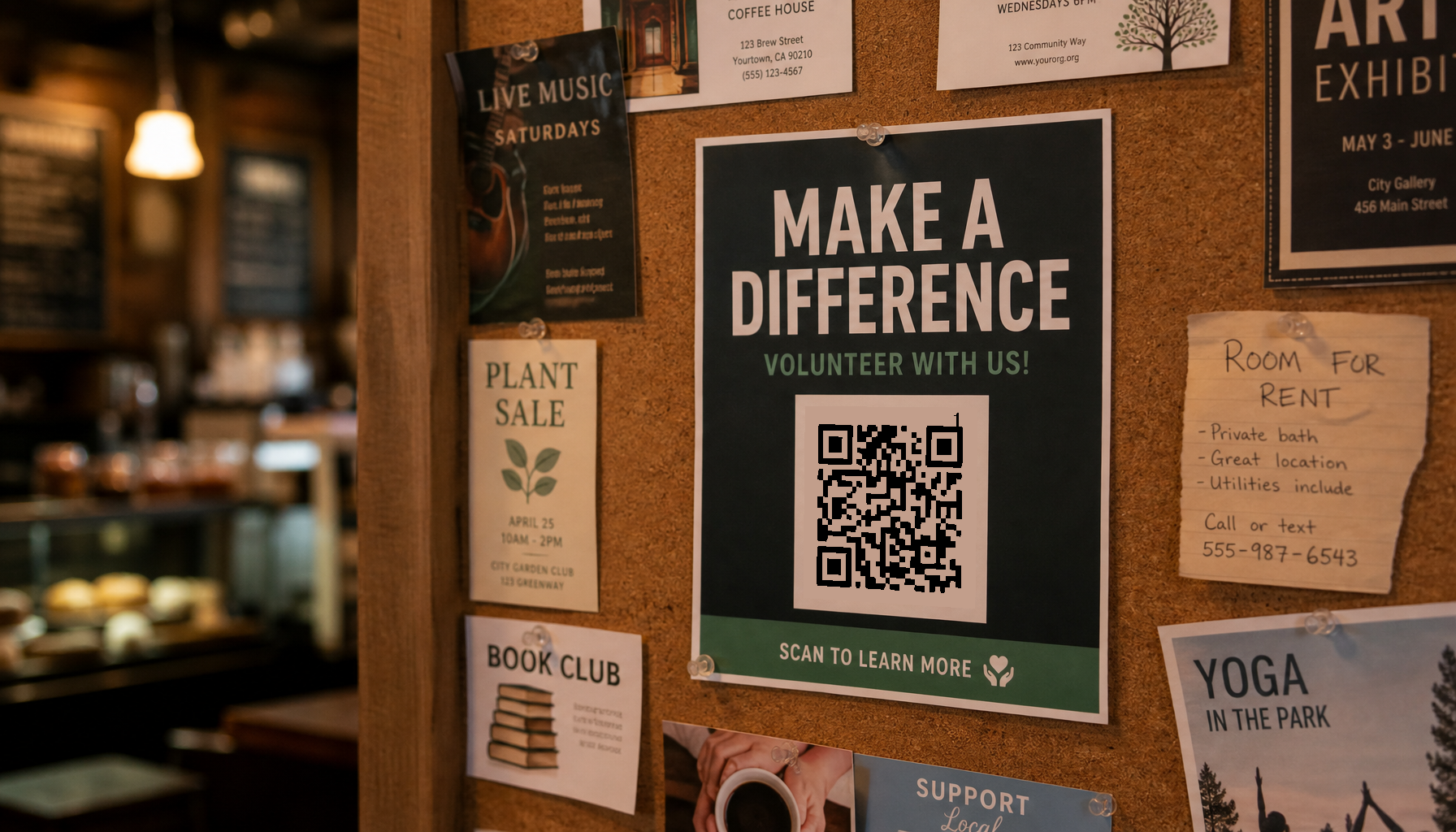
Why Bulletin Boards Still Work
Bulletin boards survive in the digital age because they serve a specific purpose: they reach people in a physical, local context.
Someone standing in line at a coffee shop has time to look. A parent at the library notices a flyer for a kids' event. A gym member scans a poster for a local race.
These are not random impressions. They are contextually relevant, geographically targeted, and often high-intent.
The problem has never been the channel. The problem has been the measurement.
The Traditional Approach: Spray and Pray
Most bulletin board campaigns look like this:
- Design a flyer
- Print 50 copies
- Drive around town putting them up
- Wait and hope
- Maybe get some calls or website visits
- Have no idea which board produced what
This approach makes it impossible to improve. Was the coffee shop board better than the library? Did the design matter? Was it worth the time to drive across town?
Without data, every campaign starts from zero.
A Data-Driven Approach
A data-driven bulletin board campaign has four steps:
1. Choose Boards Intentionally
Not all boards are equal. Track which ones perform over time. Variables to consider:
- Foot traffic
- Audience match
- Board visibility
- Competition from other flyers
- How often the board is cleared
Start with 5–10 boards and expand based on results.
2. Use Unique QR Codes per Board
This is the most important step. Every board gets its own QR code.
Why? Because then every scan tells you something specific:
- Which boards get scanned
- Which days and times are most active
- Which designs or offers perform best
- When a flyer has been covered or removed
3. Point to a Relevant Landing Page
The QR code should go somewhere useful, not just your homepage.
Examples:
- Event flyer → event RSVP page
- Service business → booking page
- Product flyer → product page with a special offer
- Recruitment flyer → application or signup form
Use UTM parameters so your analytics tell the full story:
https://yoursite.com/event?utm_source=flyer&utm_medium=qr&utm_campaign=summer&utm_content=library-board
4. Review and Iterate
After two weeks, look at the data:
- Which boards outperformed?
- Which designs got more scans?
- Did weekday or weekend placement matter?
- Should you drop any boards?
Use the answers to make the next campaign better.
What the Numbers Look Like
Here is a realistic two-week result from a 5-board test:
| Board | Scans | Flyer Cost | Cost per Scan |
|---|---|---|---|
| Downtown coffee shop | 34 | $2 | $0.06 |
| Neighborhood grocery store | 27 | $2 | $0.07 |
| Gym near main street | 18 | $2 | $0.11 |
| Community center | 9 | $2 | $0.22 |
| Library | 5 | $2 | $0.40 |
The total spend is about $10 in flyers and a few hours of driving. Without tracking, you would not know that the coffee shop and grocery store produced 61 of your 93 scans. You might keep all five boards and waste effort on the library and community center.
With tracking, your next cycle is simple: drop the bottom two boards, test two new locations, and run the same comparison again. Each cycle makes the channel cheaper and more effective.
What Makes a Good Bulletin Board Flyer
Bulletin board flyers compete for attention. A good one:
- Has a clear headline from 3 feet away
- Includes a large, scannable QR code
- Uses high contrast and minimal text
- Has one clear call to action
- Looks professional but not corporate
- Includes a date or expiration when relevant
People decide whether to engage in seconds. Make it easy for them.
Tools for Tracking Bulletin Boards
- Spreadsheet: Log each board, flyer version, and placement date
- QR code generator: Create unique codes
- Google Analytics: Track landing page visits
- Yap.Ad: Purpose-built for tracking physical placements with QR codes, location logging, and real-time scans
A Simple Campaign to Try
Next time you want to promote something locally, try this:
- Pick 5 bulletin boards in different neighborhoods
- Create 5 unique QR codes, one per board
- Print 5 flyers with the same design but different codes
- Place them and record the date
- Check scans after 2 weeks
- Keep the top 2 boards, replace the bottom 3 with new locations
That's it. After one cycle, you'll know more about local marketing than most businesses.
Conclusion
Community bulletin boards are not outdated. They're undermeasured.
A few dollars in flyers and a few hours of placement can produce a ranked list of your best local marketing real estate. The businesses that treat bulletin boards as a testable channel will consistently outspend their competitors more wisely than the ones still driving around town hoping something works.
Yap.Ad makes this easy. Create a unique QR code for each board, log where you placed it, and see real-time scans as they happen. No spreadsheet required.
Ready to find your best bulletin boards? Try Yap.Ad on your next local flyer campaign.